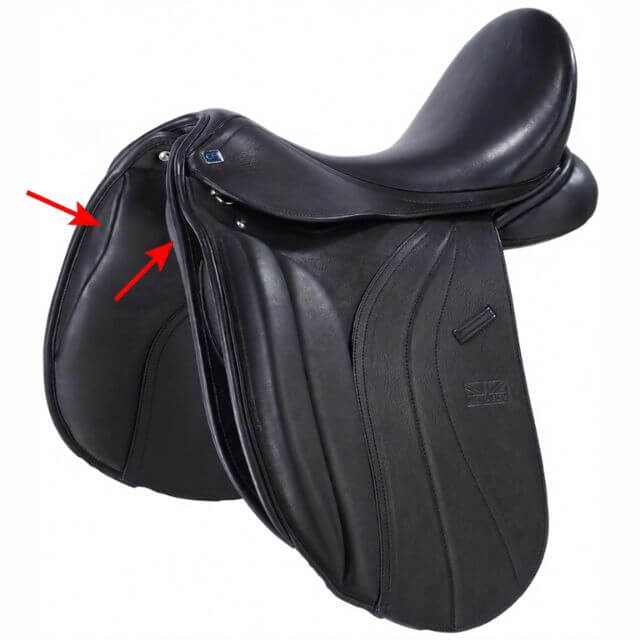
How front gusset design influences saddle balance, wither clearance and pressure distribution
When choosing a saddle, much of the attention is usually directed towards the width of the saddle tree, the shape of the withers and the overall fit of the saddle. However, the design of the saddle panels is equally important in determining how the saddle sits on the horse and how effectively the rider’s weight is distributed.
One feature that can make a significant difference is the front gusset.
The front gusset influences the volume and shape of the panel beneath the front of the saddle. Its depth and construction can help accommodate the horse’s conformation, support the front of the saddle and maintain an appropriate relationship between the saddle tree, the withers and the muscles behind the shoulder.
The requirements of a high-withered horse can differ considerably from those of a low-withered, flat-backed horse. Understanding these differences helps explain why a saddle with a deeper front gusset may suit one horse, while a slimmer, shallower panel may be more appropriate for another.
However, gusset depth should never be considered in isolation. The shape of the saddle tree, the width and angle of the tree points, the horse’s back profile and the design of the complete panel must all work together.
1. What is a front gusset?
A front gusset is a shaped section incorporated into the front of a saddle panel. It increases the panel’s internal volume, allowing the panel to accommodate more flocking or to be constructed with a fuller, more three-dimensional profile.
Depending on the saddle manufacturer, a front gusset may be relatively shallow and discreet or considerably deeper, creating a more substantial supporting area beneath the front of the saddle.
Its purpose is not simply to make the saddle thicker. The gusset forms part of the panel’s shape and influences how the saddle is supported against the horse’s back.
A suitably designed front panel can help maintain saddle balance, accommodate changes in the horse’s contours and provide appropriate contact behind the shoulder without placing excessive pressure on the surrounding tissues.
The important distinction is that a gusset changes the panel’s configuration; it does not replace the need for a correctly matched saddle tree.
2. The main types of front gusset and panel design
Saddle manufacturers use different names and construction methods for their panel designs. The following descriptions explain the common configurations and their general fitting implications.
Standard or relatively shallow front panel
A standard panel has a comparatively modest front profile and may have no distinct front gusset, depending on the manufacturer’s terminology.
This type of construction can suit horses whose back profile provides adequate support for the front of the saddle without requiring substantial additional panel depth.
Potential advantages include:
A relatively slim profile between horse and rider.
Less unnecessary bulk beneath the front of the saddle.
Appropriate contact where the horse’s back shape and the tree profile are already well matched.
However, a standard panel may not provide the volume or shape needed to support the saddle correctly on a horse with prominent withers and hollows behind the shoulder.
The suitability of a standard panel depends on the complete saddle design and the horse’s conformation, rather than the absence of a gusset alone.
Full or deeper front gusset
A deeper front gusset provides additional panel volume towards the front of the saddle. This may allow the panel to accommodate a more pronounced change in the horse’s back contour and provide support beneath the front of the tree.
On some high-withered horses, the muscles immediately behind the withers and shoulder can fall away relatively steeply. A suitably designed deeper gusset may help accommodate this transition and support the saddle without forcing the tree down onto the withers.
Potential benefits include:
Better accommodation of hollows behind prominent withers.
More appropriate support beneath the front of the saddle.
Improved saddle balance where the existing panel profile is insufficient.
Greater scope for adjusting the panel’s shape through suitable flocking.
A deeper gusset is not automatically the correct choice for every high-withered horse. If the tree shape or width is unsuitable, additional panel depth cannot reliably correct the underlying mismatch.
Wither gusset or dropped front panel
Some saddle designs incorporate a specialised wither gusset or a dropped front panel. These configurations are intended to accommodate particular combinations of prominent withers and the surrounding back contours.
A dropped panel changes the position and shape of the supporting surface relative to the saddle tree. A wither gusset adds volume in a targeted area. The exact construction varies between manufacturers, and these terms should not be treated as interchangeable.
Such designs can be useful where the horse has a pronounced wither profile and a dip behind the shoulder, but the result must be assessed in relation to the tree, the horse’s back and the saddle’s position under load.
Panel designs for low-withered, broad or flat-backed horses
Horses with low withers and broad, relatively flat backs often need a different panel profile from horses with prominent withers and steep changes in contour.
A slimmer, shallower front panel may reduce unnecessary bulk and help the saddle sit in a more appropriate relationship with the horse’s back.
The objective is not to remove support, but to provide the correct amount of support in the right places. A panel that is too bulky or too deep for the horse may alter the saddle’s balance or create localised loading.
It is also important to distinguish a flat-backed horse from a low-withered horse. These characteristics often occur together, but they are not the same. A horse can have relatively flat back contours and still have prominent withers, requiring a more specialised approach to panel selection.
3. How front gusset depth affects high-withered horses
High-withered horses can present particular challenges because the saddle must accommodate the height and shape of the withers while maintaining appropriate contact with the muscles on either side of the spine.
Some horses have long, prominent withers that continue well back into the saddle-bearing area. Others have pronounced withers combined with a hollow or steep transition behind the shoulder.
These differences matter because two horses described as high-withered may require very different saddle and panel configurations.
Why a deeper front gusset may be beneficial
Where the horse’s back falls away behind the withers, a suitably shaped deeper front gusset may provide additional support beneath the front of the saddle.
This can help the saddle remain appropriately balanced while accommodating the horse’s contours. In certain designs, deeper front and rear gussets are used together to support the saddle along a more pronounced back profile.
The objective is to achieve suitable contact behind the shoulder without allowing the front of the saddle to descend onto the withers or place excessive pressure on the surrounding tissues.
A deeper gusset may also provide greater scope for appropriate flocking adjustments, where the panel construction permits them.
What happens when the front gusset is too shallow?
If the front panel does not provide the support required by the horse’s back profile, the saddle may not maintain its intended balance under load.
Depending on the tree and panel geometry, the saddle may settle excessively at the front, alter its balance or concentrate pressure in particular areas.
On a high-withered horse, this can compromise clearance above or alongside the withers if the saddle’s structure and position allow it to descend towards them.
The consequences are not determined by gusset depth alone. Tree width, tree angle, tree profile, panel shape and the horse’s muscular contours all influence the final fit.
Why simply adding more flocking is not always the answer
It may be tempting to solve a lack of front support by adding more flocking to an existing saddle. However, flocking can only make an appropriate adjustment within the limits of the panel and tree design.
Excessive or poorly distributed flocking can create localised pressure, reduce the available supporting surface or alter the saddle’s balance.
Where a horse has prominent withers, the solution may require a different tree profile, a suitably designed panel or a combination of both rather than simply increasing the amount of material beneath the front of the saddle.
The priority is to achieve appropriate clearance and load distribution without creating pressure beside the withers or restricting the shoulder.
4. How front gusset depth affects flat-backed horses
A flat-backed horse generally has a relatively level back profile, often accompanied by low withers and a broad rib cage. Many cobs and native-type horses display some of these characteristics, although conformation varies considerably between individuals.
These horses may require a saddle with a flatter tree profile and a relatively slim panel configuration. Where the front gusset is unnecessarily deep, the additional bulk can interfere with the relationship between the saddle and the horse’s back.
Why a shallower front panel may be more suitable
Where the horse’s contours do not require additional front-panel volume, a shallower or slimmer design may help the saddle sit closer to the intended balance.
Potential advantages include:
Less unnecessary bulk between the saddle and the horse.
Better accommodation of a relatively level back profile.
Reduced risk of introducing excessive localised support through an unsuitable panel shape.
A more appropriate relationship between the front of the saddle and the horse’s shoulder region.
Panel design should also be considered alongside tree shape. A flatter back profile may require a tree that follows the horse’s overall contour rather than one designed for a more pronounced curve.
Some manufacturer-specific fitting systems use slimmer front and rear gussets for low-withered, flat-backed horses to minimise bulk while retaining suitable support.
What can happen when the front gusset is too deep?
If the front panel is excessively deep or its profile does not match the horse’s back, the saddle may sit in an inappropriate position or fail to distribute the rider’s weight evenly.
Depending on the saddle’s construction, excessive front-panel volume may contribute to an altered seat balance, uneven contact or localised pressure.
It is important not to assume that every deep gusset will cause these problems. A deeper panel may be entirely appropriate for a horse with low withers but a substantial dip behind the shoulder, for example. The horse’s complete back profile matters more than a simple label such as flat-backed.
Similarly, a shallow panel is not necessarily better if it fails to provide the support needed beneath the tree.
The objective is to avoid unnecessary bulk while retaining the panel contact required for a stable and comfortable fit.
5. Front gusset depth and saddle balance
The front gusset must work with the rest of the saddle panel to maintain suitable balance and distribute the rider’s weight.
A saddle that sits too low at the front may place inappropriate pressure around the withers or alter the rider’s position. A saddle that is excessively elevated or inadequately supported at the front may also have an unsuitable balance or create uneven panel contact.
The relationship between front and rear panel depth is therefore important.
For example, a high-withered horse with a pronounced dip behind the shoulder and a more substantial back towards the rear may require a deeper front gusset alongside an appropriately shaped rear panel. In contrast, a low-withered horse with a relatively level back may be better suited to a slimmer panel profile.
These are general examples rather than fixed rules. A saddle fitter must assess the horse’s actual conformation, the tree’s shape and the distribution of contact along the panels.
A deeper front gusset cannot independently correct a saddle whose tree is too wide, too narrow or incorrectly shaped for the horse.
For more on assessing this relationship, read Saddle Balance: What Does That Mean and When Is It Correct?
6. How front gusset design can influence movement and topline development
The panel’s role is to provide suitable support while allowing the horse to move without avoidable interference from the saddle.
If the front panel does not accommodate the horse’s anatomy, localised pressure or an unstable saddle may affect comfort and movement. A horse experiencing discomfort may alter its posture, brace its back, resist bending or become reluctant to work forward.
These responses can affect the horse’s ability to work consistently and develop strength through its trunk and topline.
However, front gusset depth does not directly build topline muscle, and poor muscle development cannot be attributed to panel design alone. Training, nutrition, general health, conformation and other sources of discomfort also influence the horse’s development.
A correctly fitted saddle helps establish the conditions for comfortable movement. Suitable exercise can then support progressive strength and muscular development without the equipment introducing avoidable restrictions.
Explore the wider relationship between posture and saddle fit in Horse Thoracic Sling: Topline, Saddle Fit & Performance.
7. What should a saddle fitter assess?
When assessing front gusset design, the saddle should be considered both as an individual piece of equipment and in relation to the horse beneath it.
A professional assessment should include:
Wither shape and height: Determine the prominence, length and profile of the withers, including their transition into the back.
Back contour behind the shoulder: Identify hollows, changes in slope and the shape of the supporting musculature.
Tree profile and width: Establish whether the tree is suitable for the horse’s overall conformation. Panel depth should not be used to disguise an unsuitable tree.
Front panel configuration: Examine the gusset’s depth, shape, symmetry and available scope for flocking adjustment.
Longitudinal panel contact: Assess how the panels support the saddle from front to rear, while maintaining clearance over the spinal midline.
Saddle balance and stability: Check the saddle’s position and contact without a rider and reassess it under appropriate load.
Movement and rider position: Where appropriate, assess the horse ridden to determine whether the saddle remains stable and whether signs of discomfort or restricted movement are present.
A horse’s conformation and musculature can change over time, so a panel configuration that was once suitable may need reassessment as the horse develops or its workload changes.
For a closer look at spinal clearance, read Saddle Channel Height and Width: Why Spinal Clearance Matters for Your Horse.
Conclusion: the right front gusset for the individual horse
Front gusset depth is an important consideration when selecting a saddle, particularly for horses with pronounced withers, hollows behind the shoulder or relatively flat back profiles.
A deeper front gusset may provide useful support and accommodation for a high-withered horse whose back contour requires additional panel volume. A shallower, slimmer design may be more appropriate for a low-withered, flat-backed horse where additional bulk is unnecessary.
Neither configuration is universally correct. The appropriate design depends on the horse’s anatomy, the shape of the saddle tree, the complete panel profile and the way the saddle distributes the rider’s weight.
At Saddlemasters, we recognise that successful saddle fitting requires more than selecting a saddle by tree width or wither height alone. The relationship between the tree, front gusset, panel contact and the horse’s individual back shape must be considered together.
The aim is to achieve suitable support, stable saddle balance and appropriate wither and spinal clearance, allowing the horse to move comfortably and work effectively.
Unsure whether your saddle’s front panels suit your horse? Find out more about our Professional Saddle Fitting Service.