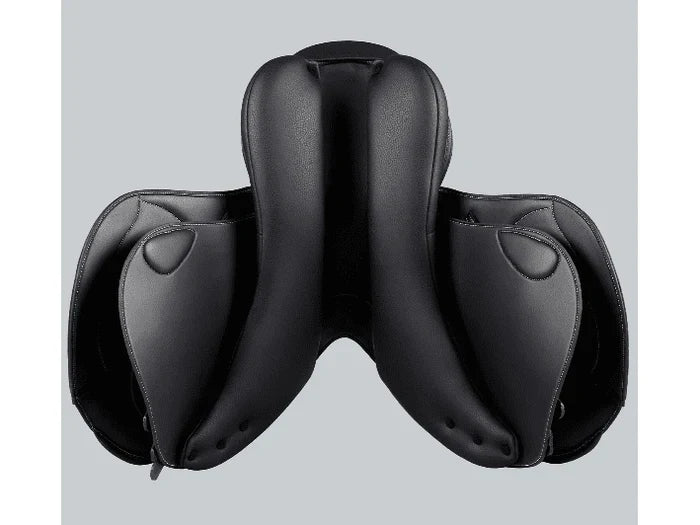
Saddle Channel Height and Width: Why Spinal Clearance Matters for Your Horse
Understanding saddle channel clearance, spinal impingement and topline development
When assessing saddle fit, attention is often given to the width of the saddle tree, the position of the saddle on the horse and the distribution of pressure beneath the panels. However, another equally important consideration is the saddle channel: the space running along the underside of the saddle designed to accommodate the horse’s dorsal spinal processes and the surrounding soft tissues.
The channel must provide sufficient clearance both vertically and horizontally, and that clearance must be maintained along the saddle’s entire length. A channel that is too low, too narrow or incorrectly shaped can interfere with the horse’s back. Conversely, a channel that is excessively wide or poorly matched to the horse’s anatomy can contribute to instability and uneven pressure distribution.
Getting this balance right is an important part of professional saddle fitting. The objective is to allow the horse to move comfortably, use its back effectively and develop its musculature without avoidable restriction from the saddle.
1. What is the saddle channel?
The saddle channel, sometimes referred to as the spinal channel or gullet channel, is the longitudinal space between the saddle panels through which the horse’s spine runs.
The dorsal spinal processes project upwards from the vertebrae along the horse’s back. These bony structures are covered by soft tissues, including ligaments, fascia and muscle, and their shape and prominence vary between individual horses.
The saddle channel must accommodate this anatomy without the saddle tree or its supporting structures, or the panels beneath the saddle, placing inappropriate pressure on the midline of the back.
Three aspects of channel design are particularly important:
-
Height: the vertical clearance between the horse’s back and the underside of the saddle’s central structure.
-
Width: the lateral space available around the spinal processes and associated soft tissues.
-
Longitudinal shape: how the channel’s height and width are maintained from the front of the saddle towards the rear.
These dimensions cannot be considered in isolation. A channel may appear adequately wide when viewed from behind but still be too low over a prominent section of the spine. Equally, it may provide sufficient clearance at the front and rear while narrowing or dropping too low through the middle.
A saddle should therefore be assessed as a three-dimensional structure in relation to the horse standing beneath it and, where appropriate, moving under a rider.
2. Saddle channel height: the importance of vertical clearance
Vertical clearance is essential because the dorsal spinal processes must remain free from direct contact with the saddle’s central structure and from inappropriate pressure transmitted through the panels.
If the channel is too shallow, the saddle may sit close to the spinal midline even when its overall width appears suitable.
What happens when the channel is too low?
Insufficient vertical clearance can allow the saddle to contact the tops of the spinal processes or compress the soft tissues surrounding them. The risk may increase when the saddle is girthed, when the rider’s weight is applied or when the horse’s back changes shape during movement.
A saddle that appears clear while the horse is standing without a rider may therefore need further assessment under dynamic conditions.
Potential consequences include:
-
Localised pressure and discomfort over the dorsal midline.
-
Sensitivity when the saddle is placed on the back or the girth is tightened.
-
Reduced willingness to lift and use the back freely.
-
Resistance to transitions, changes of direction, bending or collected work.
-
Altered posture, including a tendency to hollow or brace the back.
-
Difficulty maintaining a relaxed, consistent way of going.
These signs are not exclusive to saddle channel problems. Dental issues, lameness, other musculoskeletal conditions and training factors can produce similar behaviours. Nevertheless, spinal clearance should be investigated when discomfort or changes in performance coincide with saddle use.
Why static clearance is not enough
A horse’s back is not a fixed surface. Its shape and the relationship between the back and saddle change during locomotion. The horse bends, rotates and moves its thoracic region as its limbs advance, while the saddle and rider impose additional forces on the back.
The assessment must therefore consider whether adequate clearance is maintained when the saddle is correctly positioned and girthed, and whether its fit remains appropriate during ridden work.
Simply looking down the channel or checking the space while the saddle is off the horse cannot establish that the horse is free from pressure when ridden.
3. Longitudinal channel shape: clearance from front to back
The channel must not only have appropriate height; its shape must also correspond to the horse’s back along its entire length.
Horses vary in their spinal profile, back length, topline musculature and the prominence of the dorsal processes. Some have a relatively level back, while others have more pronounced changes in height or contour along the saddle-bearing area.
A correctly designed channel should accommodate these differences while remaining clear of the spinal midline.
A channel that is too low through the middle
A channel may provide adequate clearance at the front and rear but become too shallow through the central section. This can result in localised contact where the spinal processes or surrounding tissues are most prominent.
The problem may be difficult to identify from a quick visual inspection because the front and rear portions of the channel can create the impression that sufficient space is available.
Older saddles with a channel that narrows towards the rear
One design problem found in some older saddles is a spinal channel that begins with generous clearance at the front but progressively narrows towards the rear of the saddle.
Viewed from above, the channel may appear wide enough around the withers and the front section. However, as it continues towards the cantle, the available lateral clearance can reduce until it is insufficient for the horse’s spinal anatomy.
Spinal clearance must be maintained along the entire length of the saddle, not simply at the front where the channel is most easily inspected.
This is particularly important because the saddle panels extend along the back to support the rider and distribute the applied load. Although the rider’s principal weight-bearing area is concentrated around the seat and supporting panels, the rear section of the saddle remains important to the overall fit.
Where the channel becomes progressively narrower towards the rear, the inner edges of the panels may encroach on the tissues surrounding the dorsal spinal processes. Depending on the horse’s conformation and the saddle’s construction, this can result in reduced clearance or inappropriate pressure in a region that may not be obvious during a quick visual inspection.
The problem is especially relevant when the horse has a prominent spinal midline or a back profile that does not correspond to the saddle’s channel shape.
It is not enough for a saddle to provide generous clearance at the withers if that clearance cannot be maintained through the middle and rear of the saddle-bearing area.
How can a narrowing rear channel affect the horse?
If the rear channel is too narrow for the horse, pressure may develop alongside the spinal midline as the saddle is girthed and loaded. The effect depends on the position of the saddle, the shape of the panels, the horse’s anatomy and how the saddle behaves during movement.
Potential consequences include:
-
Localised discomfort alongside the spinal midline.
-
Protective muscular tension and altered posture.
-
Reduced willingness to bend or use the back freely.
-
Resistance during transitions and other ridden exercises.
-
Changes in movement or difficulty progressing through training.
These signs are not proof of a channel-design fault, and they should not automatically be attributed to the saddle. Nevertheless, a progressively narrowing channel warrants careful examination when the horse displays back sensitivity or unexplained changes in performance.
A common mistake is to judge channel width by looking only at the front of the saddle or by checking the space at a single point. The channel needs to be inspected longitudinally, from front to rear, with particular attention to any progressive reduction in width. Clearance must then be considered alongside the horse’s spinal profile, panel shape, saddle balance and fit under load.
The solution is not necessarily to choose the widest possible channel. It is to select a saddle whose channel maintains appropriate clearance for the individual horse throughout its length, while retaining sufficient panel contact and stability to distribute the rider’s weight correctly.
A channel that narrows or changes shape unevenly
An abrupt change in channel height, width or contour can create a localised restriction rather than providing consistent clearance. Panel construction, tree design and the way the saddle sits on the horse all influence the resulting space.
It is also important to distinguish a channel-design problem from a saddle that is incorrectly positioned or does not match the horse’s overall back profile. Either can affect clearance, but the appropriate correction may be different.
The aim is not to create a channel that is simply as large as possible. It is to provide suitable, continuous spinal clearance throughout the saddle-bearing area without sacrificing saddle stability or correct weight distribution.
4. Saddle channel width: providing sufficient lateral clearance
While channel height determines the vertical space available over the spine, channel width determines whether the spinal processes and surrounding tissues have sufficient room laterally.
These are separate considerations. A channel can be wide enough but too low, or high enough but too narrow. In either situation, the horse may experience inappropriate contact or pressure.
When the saddle channel is too narrow
If the channel does not provide sufficient lateral clearance, the inner edges of the saddle panels may encroach on the spinal midline and the tissues surrounding the dorsal spinal processes.
This can create pressure along one or both sides of the spine. The distribution of that pressure will depend on the horse’s anatomy, the panel shape, the saddle’s position and the forces applied during movement.
Possible effects include:
-
Localised pressure against the tissues surrounding the dorsal spinal processes.
-
Discomfort when the back flexes, extends or rotates during movement.
-
Reduced willingness to bend evenly through the body.
-
Resistance to transitions, lateral work or changes of rein.
-
Compensatory muscular tension and altered movement patterns.
-
Reduced tolerance of ridden work or difficulty progressing through training.
A horse experiencing discomfort may brace its back, alter its posture or change how it uses its limbs. These responses can affect the quality of movement and the horse’s willingness to work forward.
A narrow-looking channel does not automatically establish that the saddle is causing impingement. The horse’s actual anatomy, the panel construction and the clearance under load must all be assessed.
When the saddle channel is too wide
It may seem logical that a wider channel must always be better because it creates more room around the spine. In practice, excessive width can also be problematic when it is inappropriate for the horse.
The saddle panels provide the interface through which the rider’s load is distributed onto the horse’s back. If the channel is excessively wide relative to the horse’s spinal anatomy and the saddle’s overall design, the supporting panel surface may be reduced or poorly positioned.
Depending on the saddle and the horse, this can contribute to:
-
Less appropriate distribution of the rider’s weight across the available supporting surface.
-
Increased localised loading where the panels bear against the back.
-
Reduced stability if the channel width forms part of a wider mismatch between the saddle and the horse.
-
A saddle that shifts or moves more readily, particularly when the horse bends or changes direction.
-
Uneven contact that changes as the horse moves beneath the saddle.
Excessive channel width does not inevitably cause instability or pressure. Those outcomes depend on the complete saddle design, the tree, panel geometry, horse conformation and saddle fit.
The important principle is that the channel should be wide enough to provide appropriate spinal clearance, but not so wide that the saddle’s supporting surfaces become poorly matched to the horse.
5. Spinal impingement: what does it mean?
Spinal impingement occurs when structures around the spine come into inappropriate contact or experience excessive compression. In the context of saddle fitting, this may involve direct contact with the dorsal spinal processes or pressure on the adjacent soft tissues.
The term is sometimes used broadly to describe saddle-related pressure over the spinal midline. It is important, however, to distinguish an inadequate saddle channel from a diagnosed spinal condition.
One recognised veterinary condition is overriding dorsal spinous processes, often referred to as kissing spines. This involves abnormal proximity or contact between adjacent spinal processes and cannot be diagnosed simply by observing a narrow saddle channel or a horse displaying discomfort.
A horse may have inadequate saddle clearance without having kissing spines, and a horse with diagnosed kissing spines may require a veterinary-led management plan alongside specialist saddle fitting.
How can spinal impingement affect movement?
When a horse experiences back discomfort, it may alter the way it carries itself and responds to the rider. Rather than moving with a supple, coordinated back, it may adopt a more guarded posture.
Depending on the cause and severity, possible signs include:
-
A tendency to hollow or brace the back rather than use it freely.
-
Reduced willingness to stretch over the topline.
-
Difficulty maintaining rhythm and relaxation.
-
Resistance when asked to bend or perform transitions.
-
Reduced quality of engagement from the hindlimbs.
-
Shortened, restricted or inconsistent movement.
-
Behavioural changes when saddled, girthed or ridden.
These signs are not specific to spinal impingement. Lameness, sacroiliac-region pain, limb discomfort, dental problems, rider influence and other conditions can produce similar changes.
Where a horse displays persistent back pain, a sudden deterioration in performance or marked resistance to ridden work, veterinary assessment should take priority over assuming that saddle fit is the sole cause.
6. The relationship between spinal clearance and topline development
The topline comprises the muscles and associated tissues along the horse’s upper body, including the neck, withers, back and loin. Its development is influenced by genetics, age, nutrition, general health, workload, movement quality and the horse’s training.
Saddle fit can influence this process by affecting whether the horse can work comfortably and use its body effectively.
For related reading, see our guide to the horse’s thoracic sling, topline, saddle fit and performance.
How inappropriate channel clearance may restrict development
If a saddle repeatedly causes discomfort or restricts movement, the horse may adapt by bracing its back, altering its posture or avoiding certain movements.
Over time, these compensatory patterns may make it more difficult to develop the strength, coordination and muscular endurance required for the intended work.
Potential consequences include:
-
Reduced willingness to stretch the neck and back appropriately.
-
Difficulty maintaining a relaxed, swinging back during forward movement.
-
Less consistent use of the abdominal and trunk muscles involved in postural control.
-
Uneven muscular development where movement patterns become asymmetrical.
-
Reduced tolerance of training because discomfort limits the work the horse can comfortably perform.
It is important not to interpret every hollow back or underdeveloped topline as evidence of saddle-related spinal pressure. Muscle development is multifactorial, and an apparently poor topline may reflect workload, nutrition, conformation, age, illness or an underlying painful condition.
Equally, a horse can be working regularly yet fail to develop as expected if discomfort is preventing it from moving freely.
Why a correctly fitted saddle supports better movement
A saddle that provides appropriate spinal clearance and distributes the rider’s weight suitably allows the horse to perform its work without avoidable interference from the equipment.
When combined with suitable training, adequate recovery, appropriate nutrition and good general health, this creates better conditions for progressive muscular development.
The objective is not to force the horse to lift its back continuously. It is to allow normal, coordinated movement and the development of strength appropriate to the horse’s conformation and workload.
7. Can exercise improve topline development?
Appropriate exercise can help improve strength, coordination and muscular development, provided the horse is comfortable and the saddle fits correctly.
Exercises should be selected according to the horse’s current fitness, training level, soundness and individual needs. Where back pain or suspected spinal impingement is present, the underlying problem should be assessed before increasing the workload.
Useful exercises may include:
Active, relaxed forward movement: Work in a suitable rhythm, allowing the horse to move freely through its body without being forced into a fixed head-and-neck position.
Transitions: Correctly performed transitions between and within paces can encourage balance, coordination and appropriate engagement of the hindlimbs. They should not be used to force a painful or resistant horse into a more collected posture.
Large circles and gentle changes of direction: These can help develop balance and coordination when performed without excessive bending or loss of rhythm.
Raised poles: When appropriate for the horse’s fitness and soundness, polework can encourage limb coordination and changes in trunk posture. The exercise should be introduced progressively and stopped if discomfort or deterioration in movement occurs.
Hill work: Carefully graded walking on suitable inclines may help develop strength and coordination. The terrain, gradient and duration must suit the horse, and the exercise should not be prescribed indiscriminately for horses with back or limb pain.
Groundwork and in-hand exercises may also be useful as part of a structured programme designed by a suitably qualified trainer or veterinary rehabilitation professional.
No exercise programme can reliably overcome persistent saddle-induced pressure. Correct saddle fit and appropriate veterinary care, where indicated, must come first.
8. How a professional saddle fitter assesses channel clearance
A professional assessment should consider the channel as part of the complete saddle-and-horse combination rather than treating width or height as isolated measurements.
The assessment may include:
-
Examination of the horse’s back: Assessing conformation, muscle development, spinal prominence, existing sensitivity and any asymmetry that may influence fit.
-
Inspection of the saddle: Examining the tree and panel design, channel dimensions, panel condition and the relationship between the saddle’s shape and the horse’s back.
-
Assessment along the full channel: Checking that appropriate clearance is maintained from front to rear, rather than relying on a single viewing point.
-
Assessment of the saddle in position: Evaluating saddle placement, balance, stability and the relationship between the panels and the horse’s anatomy.
-
Assessment under load: Where appropriate, checking whether the fit remains suitable when girthed and ridden, with attention to movement, saddle stability and signs of discomfort.
-
Review of the wider fit: Considering tree width, tree profile, panel contact, rider balance and the horse’s intended discipline.
The saddle should provide sufficient clearance without compromising the supporting contact needed to distribute the rider’s load. There is no single channel measurement that is suitable for every horse, and visual clearance alone cannot establish that pressure is absent.
If there is persistent pain, marked sensitivity, an unexplained change in movement or a suspected spinal condition, veterinary investigation may be necessary alongside saddle assessment.
Conclusion: the right balance between clearance and support
Saddle channel height, width and longitudinal shape are important elements of saddle fit. Insufficient clearance may expose the horse to inappropriate pressure over the spinal midline, while excessive width or a poorly matched channel design may compromise the relationship between the saddle’s supporting surfaces and the horse’s back.
The consequences can extend beyond local discomfort. A horse that cannot move comfortably may change its posture, resist particular movements and struggle to progress through training. These changes may affect the conditions needed for healthy topline development, although saddle fit is only one of several factors involved.
The aim of professional saddle fitting is therefore not to maximise channel dimensions, but to achieve appropriate, continuous spinal clearance alongside stable positioning and suitable weight distribution.
At Saddlemasters, we recognise that every horse has its own conformation, muscular development and movement requirements. Assessing the saddle in relation to the individual horse, the rider and the intended work is essential to achieving a comfortable and functional fit.
If your horse shows back sensitivity, changes in performance or difficulty developing its topline, a professional saddle-fit assessment can help identify whether the saddle may be contributing to the problem. Where pain or a spinal condition is suspected, veterinary assessment should also be considered.