The Horse’s Thoracic Sling: Understanding Topline Development, Saddle Fit, Movement and Performance
How the thoracic sling supports the horse’s ribcage, why its function can change, and how correct training, saddle fitting and bitting choices work together to support comfort and performance.
When assessing a horse’s shape, topline or way of going, attention is often focused on the back, neck, hindquarters and saddle. However, one important area that deserves closer consideration is the horse’s thoracic sling.
The thoracic sling plays a fundamental role in supporting the horse’s trunk between its forelimbs. Its function influences how the ribcage is carried, how the forelimbs move, and how the horse coordinates its body during ridden work. Changes in its muscular development and function can also contribute to noticeable changes in the horse’s outline, topline and the way a saddle sits and behaves.
Understanding this relationship is particularly valuable when a horse is progressing through training, returning to work, developing fitness or experiencing changes in performance. It also helps explain why saddle fitting and bitting should be considered as complementary parts of the wider horse-and-rider assessment, rather than as isolated equipment choices.
What is the horse’s thoracic sling?
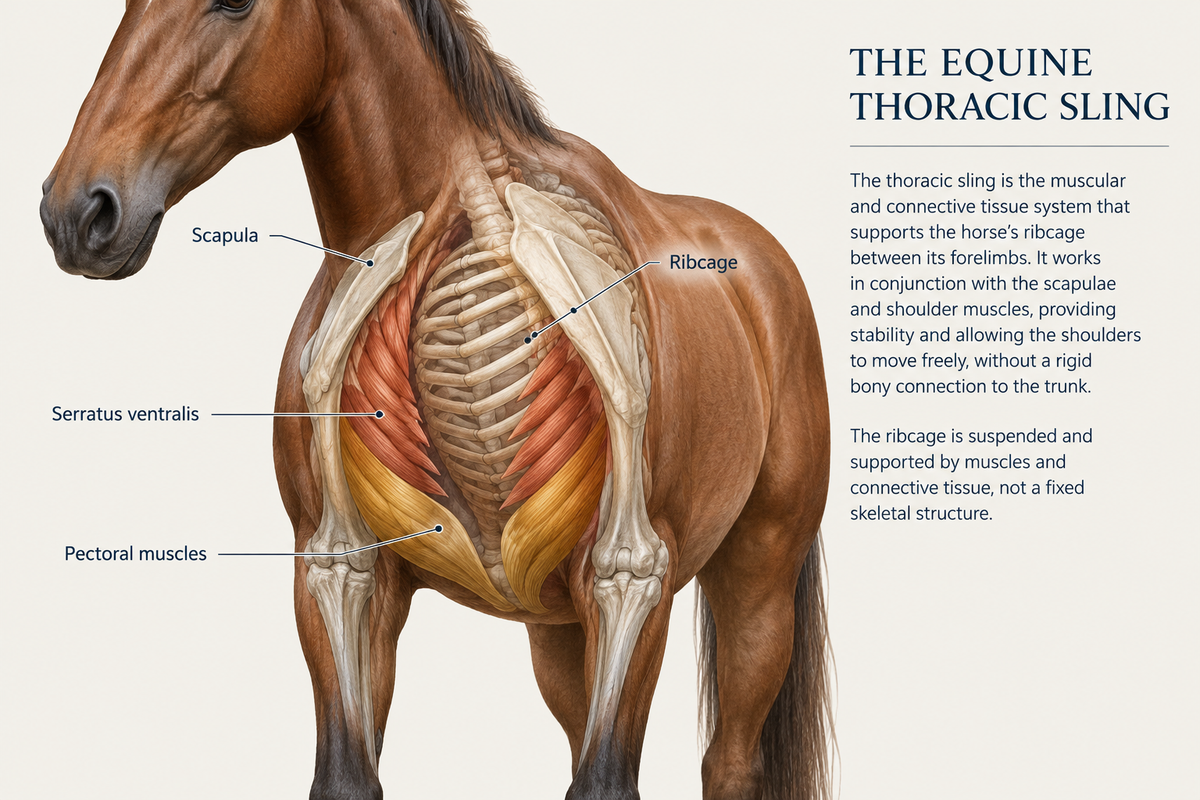
The thoracic sling is the muscular and connective-tissue system that supports the horse’s thorax, or ribcage, between its forelimbs.
Unlike humans, horses do not have a collarbone (clavicle) connecting their forelimbs directly to the trunk. Instead, the forelimbs are connected to the body primarily through muscles and associated soft tissues. This arrangement allows the trunk to be supported while the shoulders and forelimbs retain the mobility required for locomotion.
Important muscles involved include the serratus ventralis, the pectoral muscle groups and the trapezius, alongside other muscles that contribute to shoulder movement and trunk control.
The serratus ventralis is particularly important because it forms a substantial part of the muscular support between the forelimbs and the thorax. Together, these structures help support the horse’s body weight, manage movement and distribute forces generated during locomotion.
It is helpful to think of the thoracic sling as a dynamic muscular support system rather than a rigid structure. It must respond continuously as the horse walks, trots, canters, jumps, turns and carries a rider.
This is not simply a matter of strength. Effective function also depends on muscular coordination, appropriate mobility, balance and the ability to adapt to changing demands.
How does the thoracic sling support the ribcage?
During movement, the horse must control the position of its trunk while each forelimb moves through its own sequence of loading, support and swing.
The thoracic sling helps maintain the relationship between the ribcage and the forelimbs. It contributes to supporting the trunk against gravity, controlling the movement of the thorax and allowing the shoulders to function without a rigid bony connection to the body.
When the horse moves efficiently, the supporting muscles coordinate with the rest of the musculoskeletal system to accommodate changes in posture and loading.
Under saddle, the demands increase. The horse must manage its own body weight, the rider’s weight, the movement of the rider and the forces generated by the chosen discipline.
A horse working on straight lines, performing lateral movements, jumping fences or negotiating changes of pace will encounter different demands. The thoracic sling therefore needs to respond to the task rather than remain in one fixed position.
The objective is not to hold the ribcage artificially high or to create a particular outline. It is to develop the strength, coordination and mobility that allow the horse to carry itself and move comfortably.
The relationship between the thoracic sling and the horse’s topline
The thoracic sling is not the same structure as the topline, but its function is closely related to the way the horse carries its trunk and presents its outline.
The topline includes the muscles and other structures along the neck and back, including the epaxial muscles that lie alongside the spine. The shape we see is also influenced by skeletal conformation, body condition, muscle development, age and the horse’s current level of fitness.
When the thoracic sling is functioning effectively, the horse may be better able to maintain an appropriate relationship between the ribcage, shoulders and trunk during movement. This can accompany improvements in posture, coordination and the development of the muscles that support ridden work.
However, it is important not to assume that every change in topline is caused by the thoracic sling. A horse can lose muscle over its back because of reduced work, inadequate nutrition, pain or a poorly fitting saddle. Similarly, a change in the height of the withers relative to the surrounding muscles may reflect a combination of factors rather than a single muscular weakness.
Positive changes: when development improves function
As a horse becomes fitter and develops the strength required for its work, several changes may become apparent:
Improved trunk support: the horse may maintain a more consistent posture without appearing to drop through the base of the neck or the area behind the shoulders.
Better coordination: the horse may show improved control of its shoulders and trunk during transitions, turns and changes of direction.
Improved muscular development: with suitable training, nutrition and recovery, the muscles supporting the shoulders, neck and back may become more developed.
More consistent ridden movement: the horse may find it easier to maintain rhythm, balance and an appropriate connection between the forehand and hindquarters.
Greater capacity for work: improved strength and coordination can help the horse meet the demands of more advanced schooling, jumping or competition.
These changes are not guaranteed to occur in a particular sequence, and a more elevated outline is not, by itself, proof of improved thoracic sling function. The horse’s comfort, movement quality and ability to perform its work are more meaningful indicators.
Negative changes: when function deteriorates or becomes compromised
The thoracic sling may also be affected when the horse is insufficiently conditioned, working beyond its current capabilities, compensating for discomfort or recovering from an injury.
Possible contributing factors include:
Reduced exercise or a prolonged period of rest, resulting in loss of conditioning.
Sudden increases in workload without adequate preparation.
Pain or restricted movement elsewhere in the body, causing the horse to adopt compensatory movement patterns.
Poor saddle fit or persistent saddle pressure that discourages normal movement.
General loss of muscle associated with weight loss, illness, ageing or inadequate nutrition.
Training that repeatedly restricts natural movement or demands a level of balance and strength the horse has not yet developed.
A horse may consequently appear to drop through the base of the neck, develop a less defined topline or struggle to maintain its balance in ridden work. It may also show reduced willingness to move forwards, difficulty with transitions or reluctance to engage in particular exercises.
These signs are not diagnostic of a thoracic sling problem. They can also occur with lameness, back pain, limb discomfort, dental problems, saddle-related pain or other veterinary conditions. Persistent or sudden deterioration should therefore be investigated rather than addressed through strengthening exercises alone.
Why the horse’s shape can change throughout the year
One of the important considerations in saddle fitting is that a horse is not a static shape.
Its body changes in response to workload, fitness, diet, body condition, age and the demands placed upon it. These changes may be gradual, or they may become apparent over a relatively short period.
For example, a horse returning to consistent work after a break may initially have less muscle supporting the trunk and back. As its fitness improves, muscular development may change the contours around the shoulders, withers and back.
A competition horse moving from general fitness work into more demanding schooling may develop differently from a horse whose workload has been reduced. Equally, an increase in body weight does not necessarily represent an improvement in muscular development.
It is important to distinguish between muscle, fat and changes in posture. A horse can look fuller through the back because it has gained condition without having developed the strength and coordination required for its work. Conversely, a horse can become fitter and more muscular while its outline changes in ways that make an existing saddle less suitable.
These changes matter because the saddle must accommodate the horse’s current shape and movement, not the shape it had several months earlier.
Exercises that support thoracic sling development
Developing the thoracic sling is best approached as part of a progressive conditioning programme. The aim is to improve the horse’s strength, coordination and ability to carry its trunk comfortably while allowing the head, neck, shoulders and back to move appropriately.
No single exercise will strengthen every component of the system. Exercises should be selected according to the horse’s fitness, conformation, training history and any veterinary or rehabilitation advice.
1. Correct, active walking
Purposeful walking on suitable, level ground is an excellent starting point for many horses.
Allowing the horse to walk forwards with a comfortable, unrestricted head and neck position encourages it to coordinate its limbs and trunk without the greater demands imposed by faster work.
Gradually introducing varied terrain, where safe and appropriate, can increase the physical demands of the exercise. The horse should remain balanced and confident rather than being hurried or forced into an outline.
For horses returning to work, walking can provide a foundation before more demanding exercises are introduced.
2. Pole work
Ground poles can encourage the horse to pay attention to foot placement, adjust stride length and coordinate limb movement.
Begin with a small number of poles at a suitable distance for the horse’s natural walk or trot. The spacing should be adapted to the individual rather than assuming that one distance suits every horse.
As the horse becomes more confident and physically capable, pole arrangements can be varied to develop coordination and rhythm.
Pole work should not be used to force the horse to lift its forehand or raise its head. The objective is controlled, comfortable movement. Repeatedly striking poles, rushing through the exercise or showing increasing tension indicates that the exercise may be too difficult or that another issue needs investigating.
3. Gentle hill work
Walking up gentle slopes, where footing is secure, can increase the demands placed on the horse’s trunk and limbs.
The incline should be appropriate for the horse’s fitness and the exercise should remain controlled. Long, steady periods of walking are generally more suitable for building a foundation than repeatedly asking an unfit horse to tackle steep slopes.
Downhill work places different demands on balance and limb control, so it should also be introduced thoughtfully.
Hill work is not a guaranteed way to strengthen the thoracic sling in isolation. It is one useful component of a wider programme that develops overall conditioning.
4. Transitions between paces
Transitions between halt, walk, trot and canter, where appropriate for the horse’s training, encourage changes in balance and coordination.
Begin with simple, well-established transitions and aim for a clear response without rushing, leaning on the reins or losing rhythm.
As the horse improves, transitions within a pace can help develop greater control over stride length and tempo.
The quality of the transition matters more than the number performed. Repeated transitions that produce tension, loss of balance or resistance are unlikely to achieve the intended result.
5. Large circles and simple lateral work
Large circles, changes of rein and carefully introduced lateral exercises can help develop coordination and control of the shoulders and trunk.
Exercises such as leg-yield and shoulder-in may be useful when the horse has the necessary foundation and can perform them without discomfort.
The aim is to improve the horse’s ability to organise its body while maintaining a consistent rhythm and appropriate freedom of movement.
These exercises should not be used to force a horse into a particular posture or to compensate for an underlying problem with its saddle, back or limbs.
6. Gradual progression and recovery
Muscular development takes time. A horse should be given an appropriate balance of work, recovery and nutritional support, with the programme adjusted as its fitness changes.
If the horse is struggling to perform exercises that were previously straightforward, becomes unusually reluctant to go forwards or shows a persistent change in its movement, the answer is not necessarily more work.
Pain, lameness, saddle discomfort and other health problems should be considered before the workload is increased.
How thoracic sling function influences ridden movement and training performance
The thoracic sling works in conjunction with the shoulders, neck, back, abdomen, pelvis and hindlimbs. Its contribution cannot be separated entirely from the horse’s overall movement.
When the horse is able to support and control its trunk comfortably, it may be better equipped to maintain balance through transitions, changes of direction and more demanding exercises.
In dressage, this can contribute to the physical foundation needed for improved balance, lateral work and the progressive development of collection.
In show jumping, the horse must coordinate its trunk and limbs during approach, take-off, flight and landing. Effective trunk control is one part of that coordination, alongside strength, technique, soundness and the demands of the particular fence.
In eventing, hacking and general schooling, the ability to adjust balance and coordinate movement across different terrain and changes of pace is equally relevant.
However, thoracic sling development does not automatically produce a better jump, greater collection or improved performance. Those outcomes depend on the horse’s overall soundness, training, conformation, rider influence and suitability for the task.
Why the head and neck matter
The position of the head and neck can influence the movement of the back and the horse’s stride characteristics.
Research published in the Equine Veterinary Journal found that restricting the head and neck in a high position reduced several measures of back movement and shortened stride length at the walk in the horses studied. This supports the importance of considering the whole horse rather than treating the head and neck as separate from the trunk.
The practical implication is not that every horse should work with its head low. Different exercises and disciplines require different postures. Rather, the horse needs the freedom to use its head and neck appropriately for balance and movement, without unnecessary restriction.
The rider’s hand, rein contact, saddle balance and the horse’s level of training all contribute to this interaction.
Thoracic sling development and saddle fitting
Changes in the horse’s muscular development can have a direct bearing on saddle fitting.
As the muscles around the shoulders, withers and back change, the available space and contours beneath the saddle may also change. A saddle that fitted acceptably at one stage of training may no longer distribute pressure appropriately after the horse has gained or lost muscle, changed body condition or altered its way of going.
A saddle that is too narrow may create excessive pressure in particular areas. A saddle that is too wide may also create pressure problems and alter the way the saddle sits on the back. Neither problem is reliably solved by assuming that a wider saddle will allow the horse to lift its ribcage or develop its topline.
Research examining saddle-tree width has demonstrated that saddles that were wider or narrower than the correct fit affected pressure distribution and aspects of the horses’ back movement. Correct fit is therefore important for both comfort and unrestricted movement.
Source: Investigation into saddle-tree width, spinal movement and saddle pressure.
Why a saddle should be assessed as the horse changes
When assessing a horse, a saddle fitter needs to consider more than the apparent width of the horse’s back.
Relevant factors include:
The shape and angle of the withers and surrounding musculature.
The clearance and fit around the withers and spinal region.
The shape of the back and the available weight-bearing area.
Saddle balance and the distribution of pressure along the panels.
Shoulder movement and the position of the saddle during exercise.
The rider’s balance, position and suitability for the saddle.
Changes in the horse’s movement between standing and ridden work.
A saddle that is too restrictive can interfere with comfortable movement and may discourage the horse from working as effectively as it otherwise could. Equally, a saddle that moves excessively or is poorly balanced can make it harder for the rider to remain stable and follow the horse’s movement.
This can become a circular problem. The horse changes shape, the saddle fit deteriorates, the horse becomes less comfortable, and its way of going may change. The resulting movement and muscular changes can then make the original fitting problem more complicated.
For this reason, saddle fit should be reassessed as the horse progresses through training, rather than assuming that one fitting will remain appropriate indefinitely.
To explore how tree shape, saddle stability and rider position interact, read our guide to saddle balance.
The relationship between thoracic sling function and bitting choices
At first glance, the horse’s thoracic sling and the bit may appear to be unrelated subjects. In practice, they are connected through the horse’s overall movement, balance and response to the rider.
The bit acts within the horse’s mouth, while the rider’s hands communicate through the reins. The horse responds to those signals using its mouth, jaw, head, neck and the rest of its body.
The horse’s ability to balance and coordinate its trunk can influence how consistently it moves into contact, how it responds to transitions and how the rider experiences the connection.
A horse that struggles with balance, experiences discomfort or has difficulty maintaining a comfortable posture may become inconsistent in its contact. It might lean on the reins, become reluctant to go forwards, raise or lower its head, open its mouth or show other changes in behaviour.
These signs should not automatically be attributed to the bit. They can reflect many different causes, including dental discomfort, oral anatomy, bridle fit, saddle discomfort, pain elsewhere in the body, training difficulties or rider influence.
The correct response is to investigate the horse as a whole before changing equipment in the hope of correcting the symptom.
Why bitting should be considered alongside saddle fit
A saddle influences the horse-rider interface through the back and trunk. The bit and bridle influence communication through the mouth and head. Both are part of the same ridden interaction, but they serve different functions and require separate assessments.
If a horse is struggling to maintain rhythm or balance, for example, it may be tempting to select a different bit to gain more control. However, if the underlying difficulty relates to discomfort, a poorly fitting saddle or insufficient strength for the exercise, a stronger bit may not address the cause.
Likewise, changing to a different mouthpiece will not strengthen the thoracic sling or resolve a saddle-fitting problem.
The aim of bitting is to provide appropriate, clear communication while respecting the horse’s oral anatomy and comfort. The bit’s width, thickness, shape, mouthpiece design and action all matter, as does the way the bridle is fitted and the reins are used.
Research into bit movement has also shown that bit design and size, head position and rein tension can influence how the bit moves within the mouth. These factors reinforce the importance of correct sizing and appropriate use rather than assuming that a particular design will solve every contact problem.
Source: Factors Influencing the Intra-Oral Movement of the Bit.
A practical example
Consider a horse that has started to lean on the hand, shorten its stride and resist transitions.
It would be premature to assume that the horse needs a different bit. A more useful assessment would consider:
Soundness and comfort: Is there pain, lameness, dental discomfort or another physical problem?
Saddle fit: Is the saddle balanced, stable and allowing comfortable shoulder and back movement?
Training and conditioning: Is the horse sufficiently fit and prepared for the work being requested?
Rider influence: Is the rider able to maintain a balanced position and provide consistent rein contact?
Bridle and bit fit: Is the equipment correctly sized and appropriate for the horse’s mouth, training and intended discipline?
The findings may indicate that one factor needs attention, or that several factors need to be addressed together.
Once discomfort and fitting problems have been investigated, a qualified bit fitter can help assess whether a different bit design or size would be appropriate. The objective is to improve communication and comfort, not to use the bit to compensate for a problem elsewhere.
Bringing the assessment together
The thoracic sling is one part of a connected musculoskeletal system. Its role in supporting the trunk makes it relevant to posture, movement and the physical demands of ridden work.
However, good performance depends on the interaction of many factors. Strengthening exercises alone cannot correct every change in topline, and a change in the horse’s outline does not necessarily indicate a thoracic sling weakness.
Similarly, neither a saddle nor a bit should be selected solely on the basis of how the horse looks when standing. The horse needs to be assessed in the context of its conformation, soundness, current workload, rider and intended discipline.
A progressive training programme can help develop the strength and coordination required for the horse’s work. Appropriate saddle fitting helps ensure that the saddle accommodates the horse’s changing shape and permits comfortable movement. Correct bridle and bit fitting support clear communication while respecting the horse’s mouth and individual requirements.
When these considerations are brought together, the objective is not simply to create a particular topline or outline. It is to help the horse move comfortably, respond willingly and develop the physical capacity needed for its training and competitive demands.
How Saddlemasters can help
At Saddlemasters, saddle fitting is approached as an assessment of the horse, rider and saddle together. A horse’s shape, muscular development and way of going can change throughout the year, so a saddle that was suitable at one stage may need reassessment as the horse develops.
Professional saddle fitting considers saddle balance, clearance, pressure distribution, shoulder freedom and the rider’s position, with the aim of supporting comfort and allowing the horse to move as freely as its conformation and soundness permit.
Where changes in movement or contact are also present, it is important to consider the wider picture rather than treating saddle fit, training and bitting as unrelated issues.
If your horse’s topline has changed, its saddle no longer appears to sit as it did, or its way of going has deteriorated, arranging an assessment can help identify whether saddle fit needs attention and whether further investigation is appropriate.
Saddlemasters provides professional saddle fitting services to support horse comfort, rider position and performance. A correctly assessed saddle, combined with suitable training and appropriate bridle and bit fitting, can form an important part of a considered approach to the horse’s long-term comfort and development.